Category

Where Are They Now? BCLI Alumni Update: Elvis Rivera

Fred

Through our Boards & Commissions Leadership Institute, we have cultivated the leadership of 168 alumni and counting who have gone on to create transformational change at every level. Alum Elvis Rivera, from our 2022-23 cohort, has been boldly leading through the Minnesota Council on Latino Affairs. Read his story below!

“When I joined the Boards and Commissions Leadership Institute (BCLI) in 2022, I knew I wanted to serve on a state-appointed board. What I didn’t fully understand yet was what that kind of leadership would require. One of the most valuable parts of the experience was the opportunity to learn directly from experienced public servants, community leaders, and board members. Through those conversations, I gained a behind-the-scenes understanding of how public boards function, the responsibilities they carry, and the realities of public service. Just as importantly, I gained the confidence to see myself serving in those spaces. I learned that effective leadership isn’t about having all the answers. It’s about understanding systems, listening intently, asking better questions, and recognizing that meaningful change takes time and collaboration.

Those lessons prepared me to serve on the Minnesota Council on Latino Affairs (MCLA), where I have represented District 3 since June 2023. Serving on MCLA has challenged and strengthened my leadership in ways I hadn’t anticipated. The work has reinforced that public service rarely comes with perfect agreement. More often, it requires bringing together diverse perspectives, navigating complex public issues, and staying focused on serving the public good. I’ve come to realize that advocating for community is less about choosing sides and more about choosing solutions. Whether discussing economic opportunity, issues affecting immigrant communities, or other priorities impacting Latinx Minnesotans, some of our most meaningful work has involved shaping recommendations for state leaders while ensuring community voices remain at the center of difficult conversations. At times, those discussions have reflected the uncertainty and complexity many people are experiencing, particularly within immigrant communities. They have also reminded me that progress depends on our willingness to stay engaged, even when agreement isn’t immediate.

A leadership book I recently finished introduced the idea of staying ‘on the line’ during moments of uncertainty. That phrase has stuck with me because it captures so much of what public service has taught me. I’ve learned that real leadership often begins with listening, building trust, and creating space for people to work through difficult challenges together.

Looking back, BCLI did more than prepare me to serve on a state-appointed board. It sparked a commitment to continually grow as a leader. Since then, I was honored to be selected as a Bush Fellow, and as part of that journey I’ve intentionally pursued opportunities to learn from leaders across the country and around the world. Those experiences have shown me countless examples of people creating transformational change through innovation, grit, and cross-sector collaboration. They’ve also shown me how progress slows when organizations lose sight of the bigger picture or become unwilling to truly listen to one another. More than anything, they’ve reinforced my belief that no single organization, sector, or leader can solve our biggest challenges alone.

It’s a lesson that has continued to surface through my reading and leadership experiences. The more I’ve learned, the more convinced I’ve become that lasting solutions are built by bringing together government, business, philanthropy, education, and community. That belief is also reflected in the focus of my Bush Fellowship. My Bush Fellowship is centered on expanding economic opportunity by helping close the racial wealth gap through greater access, financial literacy, and education. I believe education is the foundation that allows each generation to build upon the sacrifices of those who came before them. To me, that work is one expression of a much broader responsibility we all share to leave our communities stronger than we found them.

I stand on the shoulders of giants who walked so that we could run. They did their part for us. Now it is our responsibility to do our part for those who come after us. Our actions are watched, our example is emulated, and the work we do today helps determine the opportunities available to the next generation. That’s why I often say, ‘Those that can should. I can, so I will.’ I’ve always believed public service is part of our responsibility to one another.

In a time marked by polarization and division, I believe our greatest opportunity is not to retreat into our differences but to lean into collaboration. Leadership is not about having the loudest voice. It’s about bringing people together around a shared purpose, staying at the table long enough to build trust, and leaving our communities stronger than we found them.

Through our Boards & Commissions Leadership Institute, we have cultivated the leadership of 168 alumni and counting who have gone on to create transformational change at every level. Alum Tim Brewington, from our 2019-20 cohort, is meeting the moment with bold leadership in Woodbury. Read his story below!

“I am a founding member of the Multicultural Advisory Committee for the Woodbury Public Safety Department, established in 2019. From the beginning, our work has required difficult and necessary conversations about pain, trust, accountability, and the possibility of building stronger relationships between law enforcement and the community we all serve.

The first true test of this committee and its relationship with the police department came on May 25, 2020, when George Floyd was murdered after a police officer kneeled on his neck during an arrest in Minneapolis, Minnesota. In that moment, I demanded that Woodbury take a public stance. I insisted that our department clearly name what had happened and create space for real, public conversations with both the committee and the broader community.

There was resistance. Eventually, the Director of Public Safety agreed to sit down with me for an interview to discuss his reaction to George Floyd’s death and to address how Woodbury Public Safety can be held accountable in its responsibility to protect and serve all residents. That moment became a turning point in our work.

Unfortunately, the conversations did not end there. Continued loss of life at the hands of police across the Twin Cities forced us to return again and again to these hard discussions. While these tragedies did not occur in Woodbury, what happens in Minneapolis and Saint Paul affects trust, safety, and community well beyond city borders. It affects us here.

I firmly believe safety is built through relationships. When community members and police officers know one another as human beings, when transparency and accountability are present, trust can grow. Trust is what makes real public safety possible. Change does not happen through silence. It happens one conversation at a time.

I am grateful for the continued commitment of the Woodbury police, fire, and EMS departments and for the men and women who strive each day to serve all residents with compassion, professionalism, and courage.

The Multicultural Advisory Committee meeting on Monday, Jan. 26—amid a long, violent ICE occupation and in the wake of Renee Macklin Good and Alex Pretti’s murders—was different from any other meeting.

In my eight years of service, I have never witnessed what I saw that night. Officers in full uniform broke down in tears over what is happening in our community. The energy in the room shifted in a way that was unmistakable. The weight of the moment was shared, unspoken, and heavy.

When those sworn to protect a community are overwhelmed by its suffering, something is profoundly wrong. This is not normal. This is not sustainable. And this is not okay. In that moment, I felt both heavy and hopeful. Heavy because of the pain we were witnessing, and hopeful because we were in community. Law enforcement and residents were together, supporting one another and choosing to face this moment side by side.

Real change begins when we refuse to look away from discomfort and instead choose accountability, connection, and action. Every honest conversation, every act of listening, and every decision to demand better brings us closer to the community we are striving to build. This work is ongoing, and it belongs to all of us. If we remain present, engaged, and willing to act, transformation is possible, one conversation at a time.”

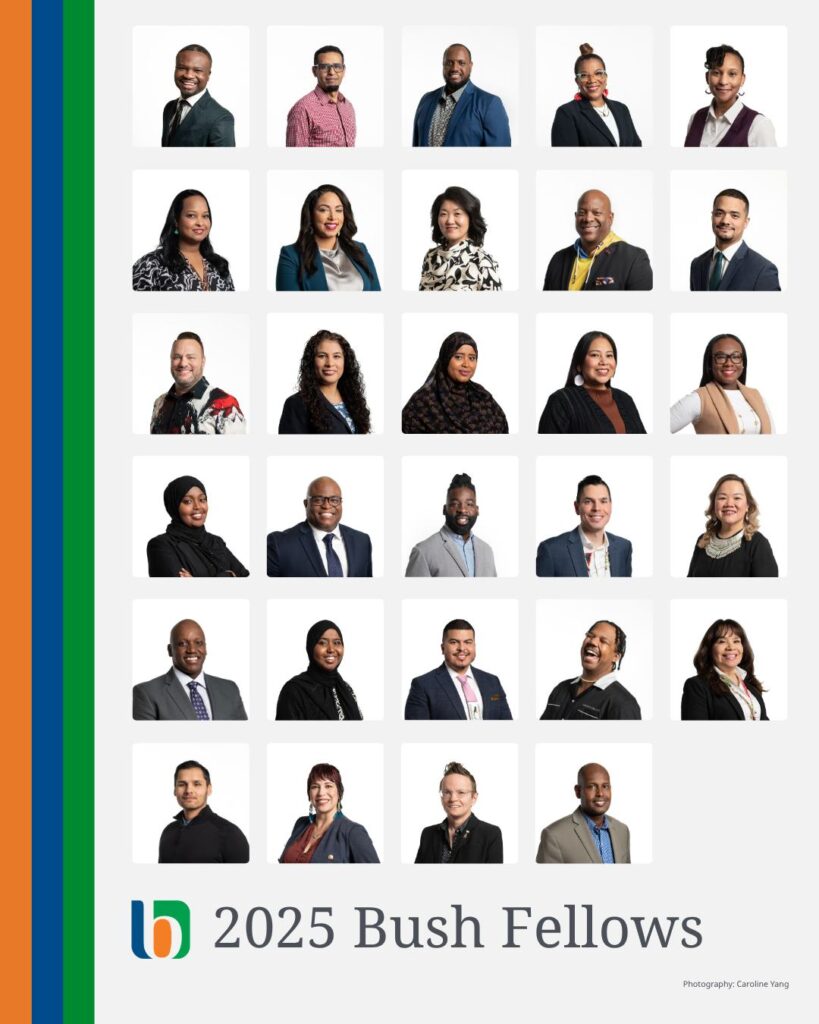
We were thrilled to see that Nexus board member Georgia Fort, BCLI alumni Carl Johnson and Elvis Rivera, and longtime Nexus partner Chanda Smith Baker are among this year’s Bush Fellows! They’re part of a group of 29 visionary leaders shaping communities in Minnesota, North Dakota, South Dakota and the 23 Native nations that share that geography. Read the excerpts below from their Bush Foundation bios!

  • “As founder of BLCK Press and the Center for Broadcast Journalism, Georgia Fort is creating pathways for Black and Brown journalists to not only enter the field, but to transform it. After being denied maternity leave as a news anchor, she left mainstream media and launched her own platform to cover underreported stories. Her team’s coverage of the George Floyd protests reached more than 18 million viewers and helped shift national narratives. Today, her newsroom is a trusted source in Minnesota, earning 12 regional Emmy nominations, three wins and national recognition for innovation and impact.”
  • Carl D. Johnson is recognized as a visionary leader committed to ensuring marginalized communities have access to healthy, culturally relevant foods. He is transforming food access and economic opportunity on St. Paul’s East Side through faith-rooted community building, radical hospitality and visionary entrepreneurship. A former gang member and addict turned pastor and community leader, Carl is the founder of the East Side’s first Black-owned grocery store, Storehouse Grocers and Coffee, as well as the George Washington Carver Cultural Center, a thriving community hub. His leadership spans worker-owned cooperatives, youth mentorship, workforce development and civic engagement.”
  • Elvis Rivera brings firsthand knowledge, professional expertise and heartfelt determination to his mission: closing the racial wealth gap for Black, Indigenous and people of color (BIPOC) communities. A first-generation Guatemalan immigrant who survived childhood homelessness and violence, Elvis arrived in Minnesota at age nine and quickly learned how poverty, racism and legal barriers shape lives. Today, as a financial advisor, nonprofit leader, and community connector, he shares the wealth-building tools often reserved for the privileged.”
  • Chanda Smith Baker has spent her life supporting people, organizations, and communities in doing their best work. A daughter of North Minneapolis and a descendant of generations of educators, advocates and builders, Chanda has led with community at the center across nonprofits, boardrooms, philanthropy and the airwaves. She envisioned North Market, co-founded the Black Collective Foundation MN, and amplifies bold voices through her podcast Conversations with Chanda.

The Bush Foundation’s Bush Fellowship is a self-designed leadership program that gives individuals the flexibility they need to develop their own capacity to lead effectively. Our Founder and CEO, Repa Mekha, is also an alum of the program!

Congratulations to all the 2025 fellows!

Image from the Bush Foundation

Our Boards & Commissions Leadership Institute (BCLI) graduated its 11th cohort this past April. We are so proud of our 157 alumni we have supported over these past 11 years. They have been working hard and advocating for equitable policies in every level of government!

As you may have noticed, we are not recruiting as usual this summer. We are shifting the BCLI program dates from October to April to April to September. BCLI’s 12th cohort will begin in April 2025 instead of October 2024. We have made this decision for the safety of our out-of-state fellows, limiting their winter travel, and to align BCLI with our budgetary calendar.

During this half-year pause, we are taking time to look back on how far we have come, celebrate all we have achieved together, and reflect on how to thoughtfully move forward, informed by our alumni’s experiences, wisdom and vision for the future.

Eleven years is a long time to run a great program, and it is time to take stock of where we are and where we are going. Specifically, we want to better understand how we can best support our alumni in their current and future projects and on their leadership journeys. How can our alumni-engagement strategies improve to meet the needs of our community? What role should BCLI play in the larger ecosystem of leadership development in the Twin Cities and Greater Minnesota? Answering these questions and others will ensure the BCLI remains relevant and impactful for years to come.

We look forward to reconnecting with the future classes of BCLI fellows and continuing to support the amazing work of our alumni, who are out changing the world by being engaged advocates for greater equity policies! Look out for information about BCLI Cohort 12 in late 2024!

First published September 2019. Words by: Nexus Community Partners and Nichelle Brunner

Nichol Ellis-McGregor is currently the MFIP Program Manager at Rise Inc., an organization that supports people with disabilities and other barriers. From 2015 – 2016, Nichol participated in Nexus’ Boards and Commissions Leadership Institute (BCLI) program. 

I had the pleasure of interviewing Nichol and we discussed her current and past work, BCLI’s influence on her personal and professional decisions, and what inspires her. 

In your current work, did you learn any skills in BCLI that were transferable to your full time work?

To influence or transform movements equitably, I have to make myself present at a table or committee or board. Even just navigating myself to get to that table, that relates to BCLI in that, I can’t make change without being at that table. I also learned that we can have differing opinions, but we need to listen to each other. Before that, I thought those folks, folks with different opinions than mine, were the enemy. I realized I needed to function less out of emotion, though I am passionate about the work, and just listen and do checks and balances to make the best decisions. 

What work have you done since that was inspired by your work in BCLI? 

I sat on the Suburban Metro Area Continuum of Care Advisory Committee, where I was basically the voice for those in suburban Anoka and Hennepin counties to get affordable housing. I went back to school. I’m currently at Northwestern for my Masters in Human Services. Generally, where I can make movement, I do. 

What is your favorite memory from BCLI? 

One of the first things that comes to mind is the affordable housing project. We were divided into two groups and created housing communities. My group got really into the glamourous aspects of housing developments, but when we presented, we realized it was out of budget and unaffordable. It was so funny because it made us realize just how hard it is to create affordable and livable housing communities. It was really a learning moment. 

Another memory is definitely graduation. I initially feared going to it because I didn’t think I was worthy because I wasn’t an activist, you know. I wasn’t out there, on the frontlines, protesting. I now consider myself an undercover transformationalist agent — I can make change within policy and the work I do. 

What is one thing you would tell someone who is thinking of applying to the BCLI? 

Your life will truly be changed and you’ll learn so much. You don’t realize how much you don’t know about our government and how much it affects you. If you really want your worldview opened up, this will be the program for you. You will open up and grow.

What inspires you?

Resiliency. It’s the person who gets things done, no matter the obstacles in their way. It’s not only the people we see on tv, but it’s the grandmother up the block. It’s my mom who is raising 6 grandkids after retirement. I am truly inspired by people who don’t give up.


For Nexus 15th anniversary, staff, community members, and program participants were interviewed to reflect on the impact of Nexus. For the “Reflections from BCLI” series, participants reflect on their experience in the Boards and Commissions Leadership Institute.